Translate

Tuesday, 12 January 2016

Bird ringing, Savernake, Sunday 10th January 2016

Hi,
Sunday was one of those fantastic days you don't want to end. The team consisted of Matt (of course), Anna, Paul, Noah, his Dad, Tim and Graham.

Setting up took no time, efficiently putting up nets down the net rides that were cleared by Matt and I in preparation for today. Half an hour later then euphoria happened, Woodcock! This is a dream bird, so to ring and hold it would be absurd and absurd it was...

 We aged this bird as a 5 (born last year) and assume that it has come from the continent, most likely Scandinavia/Russia believe it or not.  This is because satellite tagging by the Woodcock project http://www.woodcockwatch.com/ proves many are continental migrants. It weighed just over 300 grams but most incredibly I got the wing measurement spot on!
Yep I'm a skinny whippersnapper, trust me those Wellies do fit! 
Every time it wing stretched I couldn't keep its wings in position; Woodcock's are very powerful hence where they travel from and what traits they need. Nevertheless its cryptic camouflage stole the show again, simply stunning.

Our next showstopper(s) were the Redpolls, 14 of them attracted to the tape. A large proportion were adults (sixes) which could lead some to believe they had a poor breeding season. However, Matt and Graham said sometimes birds travel in flocks depending on age, I hope this is the case, further catches will prove/disprove this hypothesis. 

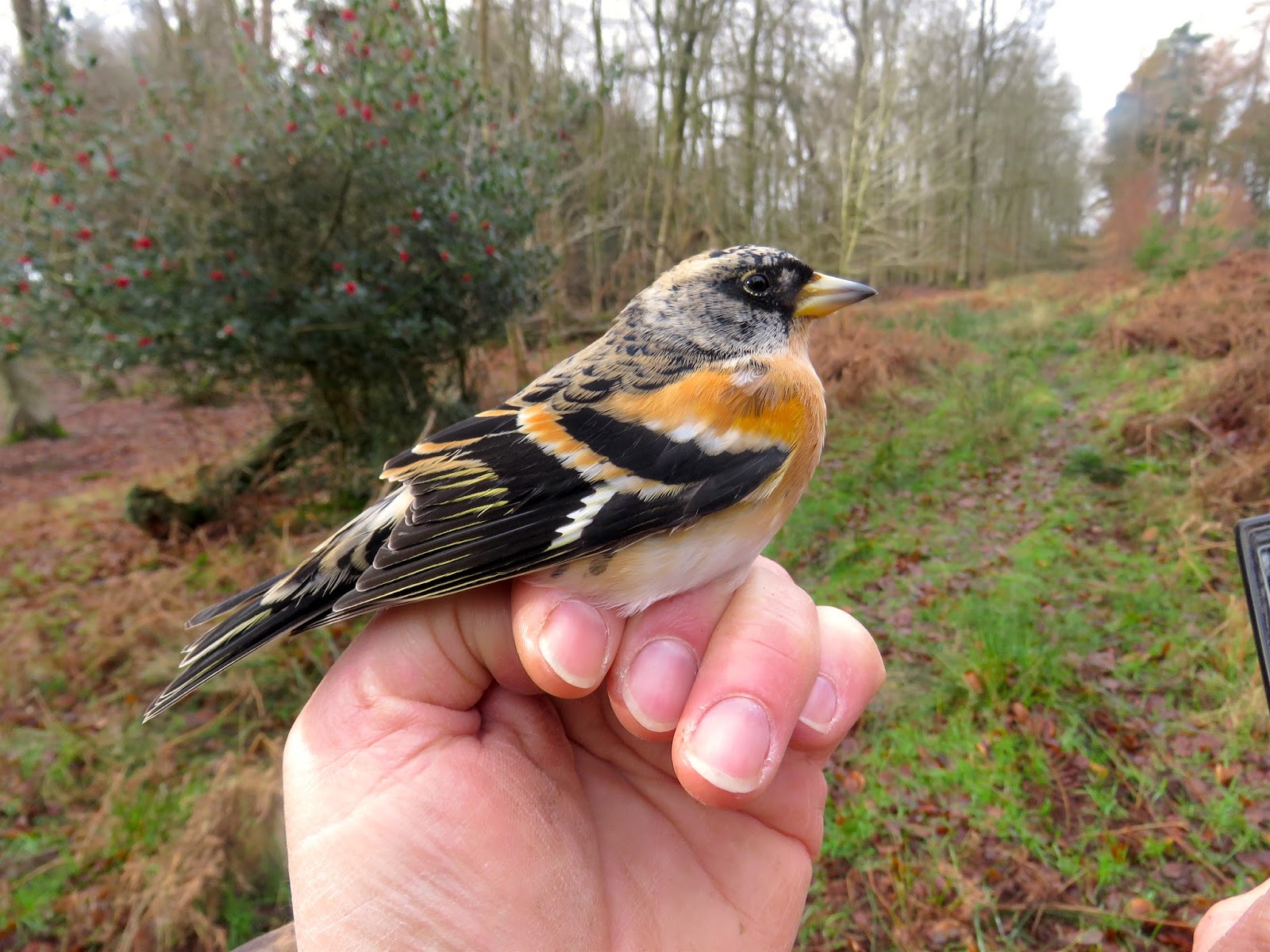
On any other day these birds would have been highlight by a mile but the Woodcock was sublime. Nonetheless Bramblings mesmerize me, particularly the males therefore catching 11 birds was brilliant. Matt has had a control (recapture of a bird not from this group that has a ring) from Norway! Data like this is brilliant so I'd be overjoyed to see one of these find their way over the North Sea into a Norwegian net; its contribution to science would be invaluable!

Pictured above is a dazzling male, showing off its orange ambience. Matt predicts this flock will grow till a peak around February/March of possibly up to a 100. Now wouldn't that be something?

 The female attempted to resemble the male but its flashes just aren't bright enough, aren't we men flamboyant, albeit clumsy (that applying to me) and less organised! I still believe the female presents a unique charm and possesses beautiful lemon armpits as does the male.
 The paparazzi were hot in this lad's tail but he seemed content perching on Matt's hand.

Another noticeable feature of Sunday's theme were the hats:

We all had are wooly hats undergoing extreme cool temperatures (5C)! Hopefully the next few weeks will provide us with out much needed winter weather...


Saturday, 9 January 2016

"Mama"... My Grandma's great shot 8th January 2016

Hi,

I seem to be on a bit of spree recently blog wise, but what's the bother? I seem to be enjoying it.
My Grandma visited Darts Farm (one of my popular birding haunts while in Devon) yesterday, eager to find a bit of white this Christmas, but no of course not snow, an Egret!

This was no ordinary Egret however, it was a Cattle, one that I have yet to see. I thought letting out my jealousy on this blog would be a way of terminating my bereavement. Both shots are from my old Canon SX50hs which looks to me like it's still producing the goods, bear in mind quality affected by email, but I hope you can appreciate what the original would be like...
Possibly a bit over exposed however I should - while with my Grandma - help resolve these issues. The prey in its mouth is in fact a Worm.
Great picture for comparison: note yellow bill of Cattle Egret (foreground), more compact look and shorter neck also straw coloured legs. 
So very Pleased with my Granny AKA Mama for producing a couple of good shots. I hope to use more of her's in the near future. 

Biff

Thursday, 7 January 2016

Cornwall, January 2nd 2016

Hi,
quick last report of what I saw on my last day down in Cornwall. I decided to stopover at Marazion on the way home for an authentic Cornish Pasty (what a joy) and in hope of finding the unfortunate Hudsonian Whimbrel. My plan of eating a pasty prevailed but my Whimbrel was to no avail, nonetheless 2 brilliant species made the visit worth while along with the pasty. 

The first was a "melanistic Pied Wagtail" that I called to my Mum and Dad which was flitting around on a a large stone wall, little did I realise that it was a pristine adult male Black Redstart giving fabulous views: 

After another good look around the few Waders on the seashore, I picked up a small dark one delicately picking up small crustaceans under stones, not a Turnstone but a Purple Sandpiper. Views obtained (as usual) were close and personal but constant "hurry up" cries failed me to land satisfactory shots. The first two are of the bird I saw today with a Turnstone in the background, the second couplet are of the views I obtained 9 months ago:

Just look at these beauties!

Believe it or not they swim!
Not a disappointing day without the - dare I say it - bland Hud Whimbrel! 

Friday, 1 January 2016

Cornwall 25th December to New Year's Day 2015-2016

Hi,
I've been having a great time down here in West Penwith, Cornwall. Although my resilience was put to the test (yep birding can be movie like) by the extreme 50mph gusts I held strong and found a few nice birds here and there. These are few of my highlights of my trip...

First of all Stonechats. These birds - for me - symbolise Penwith as they are found on any patch of Bracken, which of course is common here. Unusually there was a pair flitting between rocks on the seashore, the male was particularly showy before it dispersed into seemingly thin air!

Choughs in the last decade have quickly become a major part of the south-west Cornish landscape, with their call resonating around the rugged landscape. I seem to have become the buff of Choughs (this play on words took a while to think of so acknowledge them), for I have seen them on countless occasions. I was very sneaky this time round and managed to get very close without disrupting their avid feeding session. you won't be able to tell this however, because my hands were shaking like a Wagtail's tail in the strong winds! Contacting Nic who leads the Cornish Chough conservation project enabled me to know who these birds were: 2 yearlings who may have been in pursuit of there parents or have just reached independency. I did warn you on how bad these shots are, so grin and bear it.


The next on the list is a bit of a mouthful. A Devil's Coach Horse Beetle, no it's not a typo!
A couple of hundred metres further on than the Choughs I noticed an elongated Oil Beetle looking creature trundling across the path a foot in front of me. I knew instantly what it was and quickly directed it onto my hand. A kilometre walk on my hands were starting to hurt from its powerful jaws. But just around the corner my parents had "set up camp" for coffee and I could release it while they were drinking affording them good views. Thankfully from my perspective it gave its diagnostic and rather menacing, earwig-like, unworldly, alien etc. etc. pose. Didn't catch the moment but some nice shots nonetheless.


even though my photos are equivalent to modern art (abstract and horrible don't take offence just my opinion) it does in fact show a Merlin hawking round the cliff edge at Nanquidno. At first I thought it was a Swift and I was getting that incessant adrenaline rush with Pallid Swift in mind. Only to have a nice disappointment of it being a male Merlin! The wind was so strong it managed to keep the bird stationary for a minute until it effortlessly departed at pace round the cliff edge.

Although I didn't attain a good enough photo to post on my blog I think it's worth mentioning regular encounters with the Regulus kind, AKA Crests. Throughout my walks down into Cot Valley I was chaperoned by them, 10s of Goldcrests called from either side while Firecrests allowed fleeting glances as they light-footedly escalated Ivy bushes in pursuit of diminutive insects.

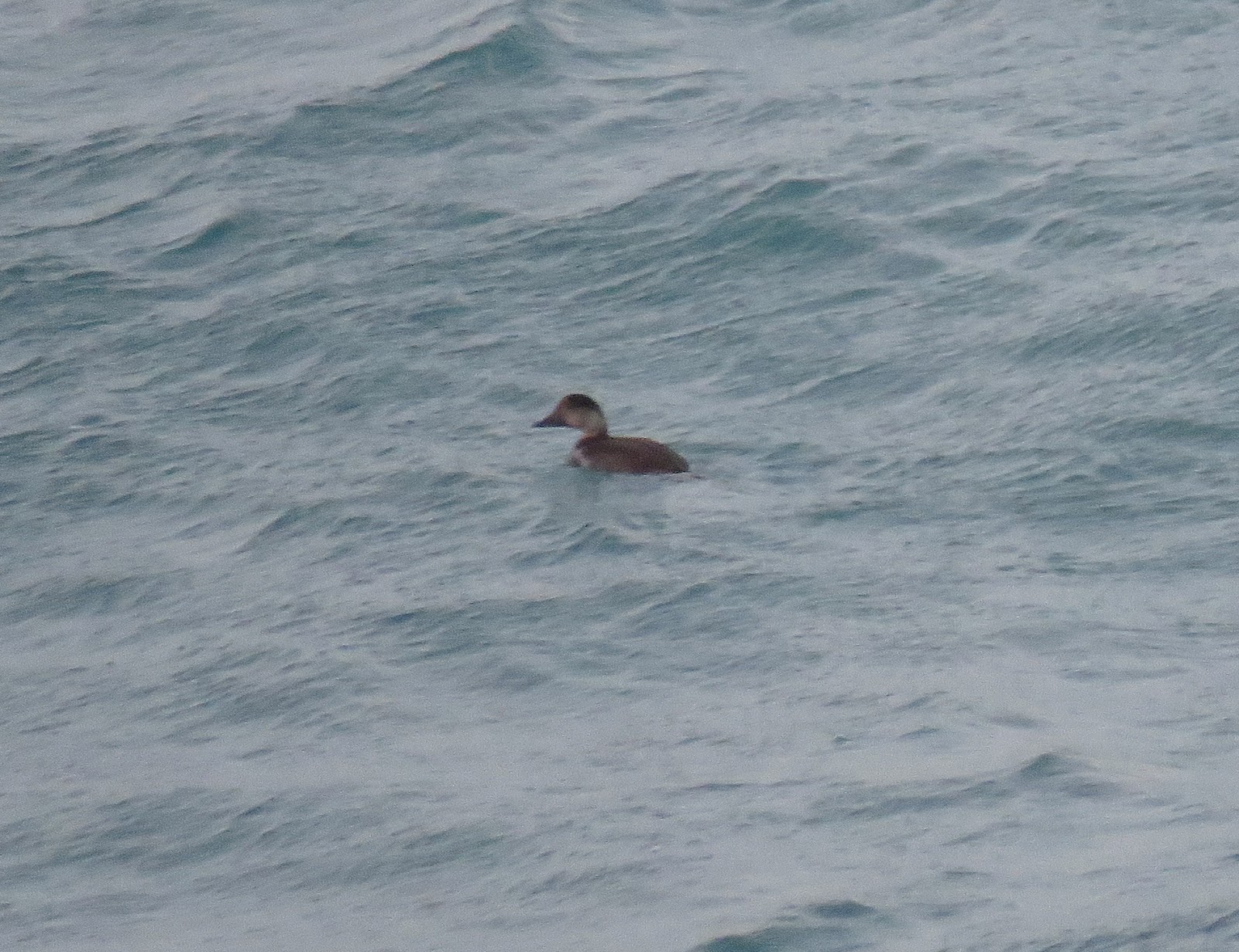
Common Scoters have always eluded me, distant unless ill and practically always at sea. Many people find large flocks migrating round prominent headlands. But I was one of the fortunate ones to see a less fortunate bird. This 1st winter female was just off Cot valley, bear in mind this is no cove just a stretch of coastline! Always getting further away, the bird didn't allow especially good photographic opportunities. I realise that I'm like a broken record but again the wind made me shake like a rattlesnake's tail!


Now to one of my most jaw-dropping episodes of the holiday gladly presented by the Great Northern Divers. These steeply browed loons travel from the northernmost reaches of Europe to winter grounds in places such as Penzance/Newlyn in search of a good spot of Common Shore Crab. While at Newlyn harbour realising the wind may force them in for cover I decided to walk on the wooden rafts in search of some. It was the correct decision, I came within 10 foot of a bird who kindly posed to counteract the horrendous light situation that has been going on since I had arrived. There were 4 in total. For me these are some of my best shots, I hope you agree:

I will post a separate piece on a beloved somewhat drab bird soon...

Monday, 23 November 2015

Smew, Corsham Lake. Lifer in Wiltshire! 22/11/2015

Hi, after checking the local bird reports I noticed that the Smew that wintered last year on Corsham Lake had returned. These (inevitably) are a rare bird for an inland site, let alone Wiltshire. It was a female with a stunning coppery red head: pristine winter plumage.

Just before my footie match yesterday - Sunday - I informed my Dad of this treat ten minutes away, he was very obliging. Off we went 2 hours before kick off to enjoy the splendour of this diving duck.

As soon as we arrived I noticed it; the beautifully delicate build coupled with the incessant diving gave the bird a unique jizz. Surprisingly tame the bird drifted to within 4-5 metres of me which I'm sure is a very unique experience. Passers by were oblivious to its presence only interested in feeding the hybrid Call Ducks further down... This has spurred me on to visit this site more often as it's so close, previous records include all the Grebes apart from Slavonian which could set my target of finding the missing link although highly unlikely! However, it is a very public area therefore disturbance is a nuisance, but could work in my favour as birds could become (as the Smew has) very accustomed to our presence, allowing fantastic photographic opportunities!

Before you're displeased with my pixelated shots, take my word for it, I'll be back for more. Hopefully an hour session to get one magical capture.

Enough of this jibber-jabber let's see the star of the show, I present the Smew:


Comparison between a Great-Crested Grebe.

Great-Crested Grebe. Juvenile, or should I say 1st winter?

Tuesday, 6 October 2015

Caithness, a new adventure 6th-10th August 2015

Hi,
I've had a fantastic time since I haven't been blogging and thought I'd catch up on a few things, this along with my well travelled, fellow naturalist Granny AKA "Mama"...

On the way up we enjoyed views of some great Scottish birds. Near Loch of the Lowes we received great views of an Osprey crossing the road, my best view ever, Red Grouse, Siskin and Yellowhammer followed. Later on we chanced across a flock of Lapwing, exactly 100 in total! It's a shame however this being classed as a highlight... We should have seen these post-breeding flocks regularly throughout the journey, but only one.

Once we got to the area of Caithness we entered the famous Forsinard Flows, which holds may of the special breeding wader records. Temminck's Stint, Wood Sandpiper, Whimbrel and Pectoral Sandpiper possibly! With the more common yet still scarce waders such as Dunlin breeding in incredible densities. We went round the perimeter but were able to see the incredibly flat, pristine blanket bog for miles. We decided to have a break at a small loch and encountered two lovely birds.
Distant, but a Red-Throated Diver stretching its wings.

A wet yet beautiful male Reed Bunting withstanding 'typical' Scottish Weather, bad stereotype.
In the evening at Scrabster, a pair of Peregrines strutted their stuff above our heads, sadly silhouetted...

The following morning I woke up early in the morning (in excitement) to be presented by a wonderful sunrise...
Just to the left of this shot I carried down along the path, only to have two diminutive Waders sway their way towards the rocks. I was expecting them to be some Turnstones, however had a nice surprise! Bobbing, brown, blobs (great alliteration)! 2 Common Sandpipers, a juvenile aged by scaling on its back and an adult. 

It was clear that they were migrants, very shifty, only allowing distant photos like these ones. But to eliminate the possibility of Spotted Sandpiper I managed shots of their wing patterns.
Unfortuantely still distant. Spotted Sandpiper (their North American species pair) would have had a less distinct wingbar, not joining with the tail feathers. Redshank and Dunlin, however, were far more co-operative.

Later on we visited Dunnet Bay, sheltered by the most northerly point of mainland Britain, Dunnet Head. 7 Great Northern Divers were using this bay, some in stonking summer plumage.
On the outskirts of the bay were loads of tiny Calidrid type Waders. Distressingly disturbed rather frequently by dog walkers/tourists. Totally oblivious to birds that may have travelled thousands of miles just beforehand. This was certainly the case for a flock of Sanderling, interestingly not whizzing along the surf but roosting on some rocks, possibly trying to escape the constant disturbance. These birds had either come from Greenland or any other high arctic staging ground.
The next day we went the full distance by visiting Dunnet Head. The most interesting bird or should I say birds. Was one fluffball and a pair of Red-Throated Divers. That fluffball was inevitably the chick, thick with down feathers to prevent the cool loch from getting to it.
This is my first ever sighting of a chick. So as one would expect, I was rather excited! We then drove back (south)! To Dunnet Bay and were glad to see our third species of Tern residing with some Black-Headed Gulls on the surf. A Sandwich Tern, adding to the previous Arctic and Common Tern sightings. My pictures I am very pleased with, as you'll hopefully agree with...

Back at Thurso I sifted through a flock of Gulls, with my patience prevailing after picking out an Argentatus Herring Gull or Scandinavian Herring Gull. Named after its more northerly distribution. The darker mantle is of note and helps to distinguish it from our bog standard Argenteus type.
Right hand bird with Argenteus to the left for comparison. Just look at the mantle (back) shade, colder.
We went to St. John's loch the next day after picking up the shockwaves produced by the groundbreaking sightings produced at St. John's pool, coincidentally a Sandwich tern colony. The surrounding area was well searched by us. Whimbrel and Ruff was found! The Ruff was the first of (too) many, well you can't get enough of Ruff's can you!?
Whimbrel, note smaller size compared to Curlew, crown and for me darker wings with a sheen.

Ruff poking its head out of the tufts of grass! Male.
When leaving for our next adventure we encountered two Knot's. Supposedly just having come from the Orkney's fiddling around in the rocks.
Here you can see a summer plumaged individual
I have far better photos of Ruff and Knot to come, watch this space!