Translate

Friday, 9 September 2016

Juvenile Arctic Redpoll - where's the beef?

Hi,

after going on a recent expedition to Arctic Norway I was exposed to (what was unbeknownst to me) the Redpoll issue. Here in the UK I get the inkling  (ignore my generalising just an impression) that many folk are splitting these Redpoll into categories that don't really exist - I for one was one of them.

To begin with (I hope to write further posts on this subjective topic) I would like to give you a taster of what I mean. Could you enlighten me on the identification of this bird?


Before going to Norway and having to study each Redpoll as if it was a new species, I would instantly rule out Arctic (it's too brown we've been told all along)! I would then focus on Mealy and Lesser. Now I hope you noticed the bill; supposedly Mealy have the largest/longest bill; this clearly has a tiny one. So there you have it a Lesser Redpoll but wait hang on a sec we're 400 miles north of the Arctic Circle so geographically it CAN'T be a Lesser. It also has only 1 dark shaft in one of its under tail coverts and it has a white rump. Hang on then, what is this telling us? We've got a bird that is meant to have the longest bill of its family yet acquires the smallest one I have seen. Get where I'm going here? 

There you have it. This whole Redpoll malarkey is all gobbledygook - yes I know we all know that, which makes this so interesting. Let's not stop here, however and try to get to the end of this mysterious juvenile bird. For me structurally (and in a few places plumage wise) this instantly gave me an Arctic Redpoll impression. I'll run through the pros: small bill, rounded, tiny head, densely feather legs, white rump and only 1 dark tail shaft. Bearing this in mind I quickly went to the web in search of a photo and/or even better description of exilipes in juvenile plumage. What did I find? Nothing. What gets me is how we can describe this as a distinct species when there's no text describing them (at least to my knowledge)! 

What I keep getting the vibes of is this being the same situation as Chiffchaffs: clinal. Collybita-trisits, cabaret-exilipes. My fellow far more experienced ringers also discussed further that night (and throughout the holiday) about this bird and Redpolls, we all came to the same educated conclusion: lump them. Of course this isn't an exact science and we still are by no means definitive but I'll leave this question for you. To lump or not to lump? That is the question.


Saturday, 3 September 2016

The Chiffchaff chronicles. An attempt at clarity: my perspective.

Hi,
for what seems like an eternity Chiffchaffs (Phylloscopus Collybita) - the mother of all LBJ's (little brown job's) - have been under the microscope. This is not because of the species pair Willow Warbler (Phylloscopus Trochilus) causing confusion. It's the infraspecific differences within the species that is causing the uncertainty. In this (sort of) essay I will include my photographs, my thoughts but will incorporate secondary sources to support my thinking of this tricky Chiffy situation.

Collybita

I will first begin by going through the ins and outs of our own subspecies of Chiffchaff: Phylloscopus Collybita Collybita. This subspecies distribution extends from the UK east to Bulgaria and Poland. Recently it's range has increase northwards nearly into Albietinus territory, Scandinavia. These are most commonly found in the summer, with a large proportion migrating from Africa in the winter to spend the spring and summer breeding in the UK. Recently (possibly due to the milder winters) more and more are becoming lazy, residing here in the UK over winter, generally around sewerage works. Up to 5000 - probably more - are wintering according to the latest counts. Which is where the tricky Chiffy situation unfolds... More on that later.
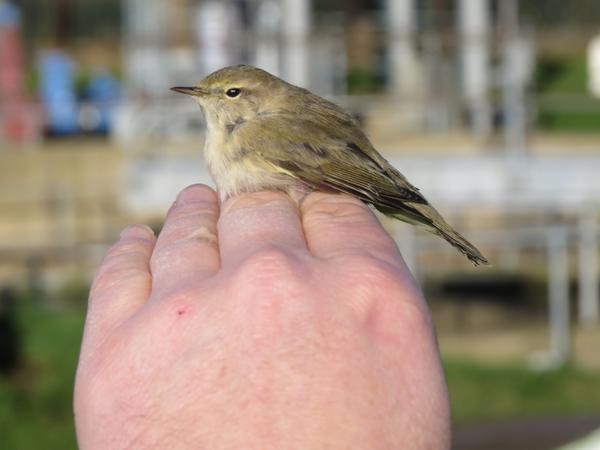
Classic Collybita type. Mantle, head and cheeks show olive wash with slightly paler bill than other ssp. Also note light tinge to supercillium unlike darker, buffier, EASTERN races. Furthermore yellow-greenish (flank) shown beneath wing which is another key.
Identification
Mantle: Collybita types have an olive green mantle. Ranging from a dull green to the brighter juvenile plumage which is yellow-greenish.
The purpose of this shot is to appreciate the colouration of the mantle and wings. The concolourus olive shade is equal throughout bird's back, even stretching to lesser and median wing-coverts along with the alula. Again typical.
Legs/ bare parts: They have dark legs with more of a brownish tinge than pure black. Their bill is generally plaer than Siberian Chiffchaff with more of a clear appearance in the field, however is not a clincher/go to identification key in the field because of it's variability. 

Flanks: subdued yellow tone extending from legs then encircles them to below the cheeks.
Here you can see two Collybita types at different positions. Attributes almost identical but clearly shows on left hand bird that the olive colouration extends to rump as well.
Facial appearance: pale cheeks with weak, yet clear yellow supercillium. Head has same olive tone as mantle that could be seen as slightly darker depending on view.
Same birds as above but this time possibly better for alternative identification; left hand bird showing yellow hue all over  body, not just in flanks which makes the job a lot opposed to a paler Collybita type.
Call: Now this is the clincher generally for identification opposed to other Chiffs. I'd describe it as a gentle weep sound, that smoothly gets higher in the short call. Calls can't be put into words to here's a link of a collybita type.  http://www.xeno-canto.org/sounds/uploaded/YEEQSGIKMT/XC165231-Tjiftjaf_20131201_04_roep.mp3

Tristis
Now for the tricky part. I will try to provide information and some photos of quintessential Tritis types that I have seen/found. But first of all, where do these birds come from? Supposedly these birds represent the far east of the Chiffchaff's range, hence Siberian, breeding east of the Pechora river and wintering in the Himalayas, while passage migrants are typically seen passing through Kazakhstan, Israel and many other eastern states. Every year several of these birds are found (normally by call) all over Britain, including inland counties which is what makes this subspecies so exciting for many. The vast majority picked out at sewage works amongst Collybita types. Sightings of these birds across the UK have been increasing annually possibly due to increased coverage and understanding over identification write ups. However, many still believe some are being picked out wrongly which is causing a major dilemma for county records nationwide, here's my attempt of resolving that issue, to you "lucky" few reading! 

Identification
Mantle: One of the first things that makes classic Tristis types stand out is the cold grey back, instantly grabbing your attention and making you wonder about the possibilities. However, as many people have suggested in the past lighting is a huge affecter on profile. In dark light generally a cold grey colour comes through but can occasionally give drab brown/grey tint, nonetheless still ultimately has some grey on show. In bright light they tend to show ice grey cast which birders generally look for when contemplating over one. However, (as I'd describe) warm light e.g. dusk or dawn the brownish pigment is more apparent out of any light condition. So is therefore something to take in mind if looking at a differing Chiff. A few sometimes posses some odd olive feathers but generally offer western subspecies genotype so: Albietinus, Fulvescens, or to be even more bewildering Tristis x Albietinus
Thankfully I recently found a Tristis type down Kenidjack Valley, Cornwall which allowed me to amass appropriate shots for an identification platform. The bird exhibits its diagnostic cold grey mantle extending up neck to head. However, if you look closely you could possibly a brownish cast within the grey which is still recognised as normal for the species as declared above. A further feature is the bare buff, if not white white flanks completely different to the olive/yellow sides of a Collybita type.
Leg/bare parts: Legs are by and large black and set side by side with a Collybita type are only just noticeably different. Legs are best to look at when light because Collybita's brownish/ochre hue is normally brought out by sunlight while Tristis stay black. I picked up that the feet are are very variable in both types so not worth too much time on. Typically bill is darker around the gape of it opposed to Collybita but good views need to be acquired before jumping to conclusions.
Same bird. The pose pictured gives indicative features of what to look out for. First of all the mantle,  it has a grey/brown that runs into the scapulars, lessers and partially into greater coverts. Furthermore, the grey hue albeit browner reaches cap, also notice buff cheeks and inconspicuous sandy coloured supercillium. For me the contrasting olive primaries and secondaries give a different and more profound look compared to Collybita who's olive mantle gently smooths into similarly coloured wings. Last point of note white clean flanks with only pallid tones near cheek. 

Flanks: These birds how no colouring on flanks if not a faint buffish far sandier/earthier impression compared to Collybita. A very handy ID feature when taking notes.
Yet again same bird. encore, buff cheeks, faint supericllium, grey/brown mantle and cap, indistinct flanks with just off-white tint and significantly conflicting pigments between wing and mantle. All these features to separate Collybita.
Facial appearance: In parallel with the mantle Siberian Chiffchaff's have a unique face which should definitely be entertained immediately upon finding the bird for physical characteristics. They have buff-grey wash cap, a lighter more buff cheek and a buff to white supercillium sporadically some birds as above have hint of yellow near front of supercillium. I would also say Siberian's have a noticeabale neck ring which nearly forms behind head. This neck ring I'd describe as a paler, colder grey which can be apparent from certain positions.
I used this picture entirely for the purpose of shade differentiation depending on light intensity. Now this bird's mantle seems to present a brighter hue which is more brown, even partially olive in some ways. Nonetheless, this bird still possesses features to counteract that view: Buff cheeks, pale supercillium, colourless flanks and dull brown cap.

Call: Linking back to what I said for call in Collybita types, this is the determining feature for identification so knowledge of call is pivotal when out in the field or else good recording equipment at hand to compare or ask for expert's opinion. Link to classic call: http://www.xeno-canto.org/sounds/uploaded/YEEQSGIKMT/XC209917-Siberische%20Tjiftjaf_20141205_01_roep.mp3

Very similar to other photos so no need to elaborate, but can help you now try and pick out what this bird has which makes it of eastern descent. There are 6 different things for me here which make it Tristis try list them, there'll be more though I'm sure!

Rather shoddy photo and position of bird, although enables comparison between two subspecies. Tristis in background and Collybita fore. Are you able to pick out the Collybita's yellow washed breast and dull green hue to mantle even if shot's not up to scratch?

Eastern Chiffchaffs


 Prewarning: I have labeled this heading as Eastern not Albietinus, Fulvescens, Brevirostris etc. For one reason that I'll explain at the end. 

While ringing the team and I have seen three Chiffchaffs which so plumage characteristics similar to Tristis and the supposed Albietinus/Fulvescens but aren't clear cut enough to name because of their "call-less" nature. Nevertheless they do show very similar features that are of note so will try and explain the thinking behind them being Eastern and why we weren't able to assign them to ssp.

Bird no. 1: Swindon STW, 22nd November 2014

While attempting to catch Redwing on migration in Swindon we (Matt, Paul and I) had the pleasure of catching a couple of Chiffchaffs as a billy bonus. Matt had spoke of seeing an eastern looking Chiffchaff but wasn't ready to call on ssp. Miraculously this bird landed in our nets for close inspection but as per usual we were still none the wiser! It refrained from calling leaving us the unfortunate, discouraging situation where we had to leave it as "Eastern". Here are the pictures:
This bird strikes me instantly as a Tristis, remember the features? cold grey mantle, buff supercillium, dark bill, clear contrast between wing and mantle, flanks clean with slight buff wash, pallid cheeks and (my id feature) paler grey neck collar. 

So not much wrong with the bird if anything, possible hint of olive near "shoulder joint" but other than that a good shout. So the only thing not going for it was the call and these birds without the call unfortunately have to pass as probable. Nonetheless, don't be disheartened many Tristis types have good site fidelity and once found should stick in the vicinity for the whole winter, so persistence is key!
Mantle again A1. But after close inspection some partial olive flickers within the grey mantle make it slightly less credible. Forcing me to conclude: eastern type. 
Just for further corroboration and analysis... The light in this angles makes neck collar even more pronounced, far paler than any other part. The darkness also causes olive traces to be invisible which is highly likely a causer of many birds to be misinterpreted. 
A view (for obvious reasons) not attained in the field but shows armpit hair (!) is yellow as a matter of fact! At least they don''t show this in the field make matters yet more problematic. Flanks are still buffish though and head distinctive.
Bird no. 2 Marlborough STW, 27th February 2015

The morning we caught this bird another suspicious looking one bundled into our nets, however was released accidentally before review. This bird for me was more of a western bird, or central Europe, for its pale shades were localised and patchy on mantle. Thankfully my ringer has had first hand experience with genuine Siberian Chiffchaffs in Kazakhstan (over 400!) so when he's company there's no going wrong with identification. No call once more but views in hand are the best of course so we could study it closely. Here are some pics:
 As you can see the bird's characteristics are very intermediate between Tristis and Collybita this lead my trainer to the Albietinus side. LIke I said, very patchy grey on mantle, subdued yellow, more colour in bill than normal (for Tristis). Linking back to my identification feature neck collar on this a pale lemony yellow with hint of grey here and there,


Another perspective, this time shows a somewhat pallid buff cheek, greyer cap and more of a buffish flank near shoulder of wing. All very strenuous but we'll get there! 

Bird 3, Kenidjack Valley, 29th-31st December 2015

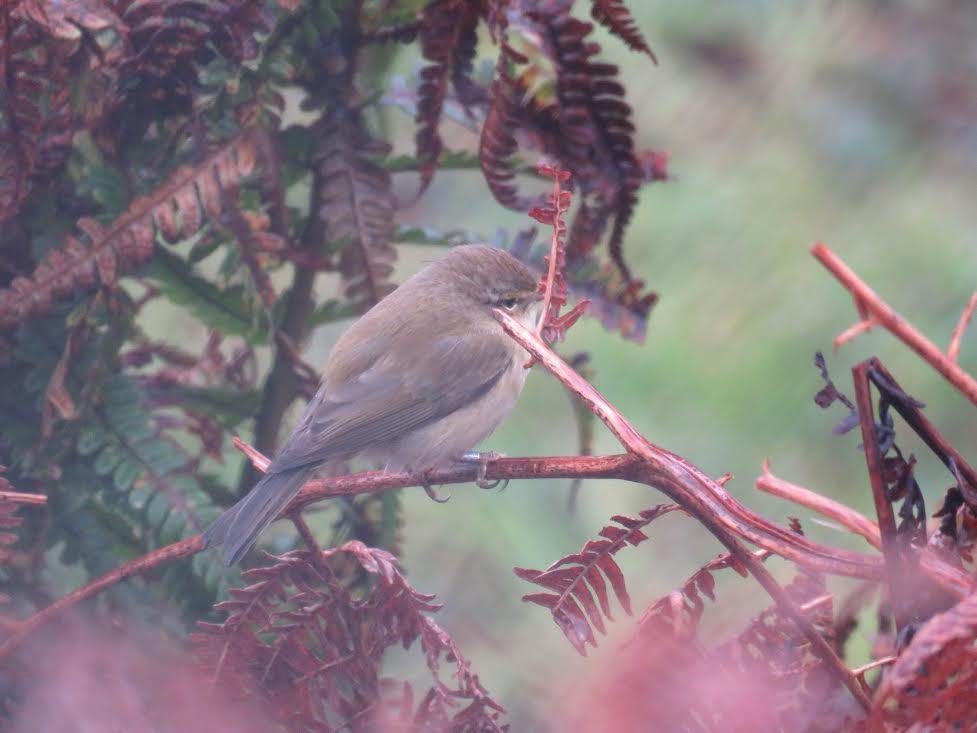
My most recent bird to complete the trio and for me the most interesting. As you can see it's a ringed bird leading me to think (for no compelling reason) that it's a British raced Chiffchaff AKA Collybita type. On the first day I saw this bird I discarded it as just an unusually brown bird. But father research later that evening on eastern type got me intrigued... First of all you can see the neck collar had faint grey feather on the tips of the old feather. Furthermore the colour is far too brown to be in the realms of any Collybita. This left me bamboozled because this bird is a) too brown for a Tristis and b) too brown for a Collybita, so what on earth is it? Well the closest match I could find was on this website of birds passing through Israel: http://www.rarebirdspain.net/arbsi026.htm
As you can see this bird is far too brown above for a Tristis and also lacks great big buff supercillum which is to be expected. But all these features don't seem to lie in those of a Collybita type, leaving many to of for Albietinus. But I have no time for Albietinus and Fulvescens and believe their true origin is a mix between the true separate species of a Siberian and Collybita type Chiffchaff. Therefore Collybita x Tristis
Another shot this time showing my id feature for Tristis, the neck collar encompassing the back of the head. However the shade is still very brown so unlike any other ssp.

Here's my bird that I was studying. Two features which I think differ from the Israeli bird and this one is the ochre/tobacco cheek of my one and feather more mottled neck collar compared to Israeli bird.
The cheek is obscured in this photo but mantle is a clearly brown with a hint of olive in the wing panel. Its head is even browner on top which is unique, apart from the Mountain Chiffchaff.
Here you can see the tobacco cheek and other supporting features.
Albeit slightly out of focus, I find this shot the most interesting out of the lot. Small buff supercillium present but too small for Tristis, sandy brown looking back now and prominent grey neck collar. Also notice buff flanks, characteristic of Tristis

Another ringed bird I saw on the next but not well enough to confirm as the day started calling and managed to record it, this is definitely a Collybita sound, making it all that more confusing! 


That's it for now I will try to explore further in future posts...


Tuesday, 12 January 2016

Bird ringing, Savernake, Sunday 10th January 2016

Hi,
Sunday was one of those fantastic days you don't want to end. The team consisted of Matt (of course), Anna, Paul, Noah, his Dad, Tim and Graham.

Setting up took no time, efficiently putting up nets down the net rides that were cleared by Matt and I in preparation for today. Half an hour later then euphoria happened, Woodcock! This is a dream bird, so to ring and hold it would be absurd and absurd it was...

 We aged this bird as a 5 (born last year) and assume that it has come from the continent, most likely Scandinavia/Russia believe it or not.  This is because satellite tagging by the Woodcock project http://www.woodcockwatch.com/ proves many are continental migrants. It weighed just over 300 grams but most incredibly I got the wing measurement spot on!
Yep I'm a skinny whippersnapper, trust me those Wellies do fit! 
Every time it wing stretched I couldn't keep its wings in position; Woodcock's are very powerful hence where they travel from and what traits they need. Nevertheless its cryptic camouflage stole the show again, simply stunning.

Our next showstopper(s) were the Redpolls, 14 of them attracted to the tape. A large proportion were adults (sixes) which could lead some to believe they had a poor breeding season. However, Matt and Graham said sometimes birds travel in flocks depending on age, I hope this is the case, further catches will prove/disprove this hypothesis. 

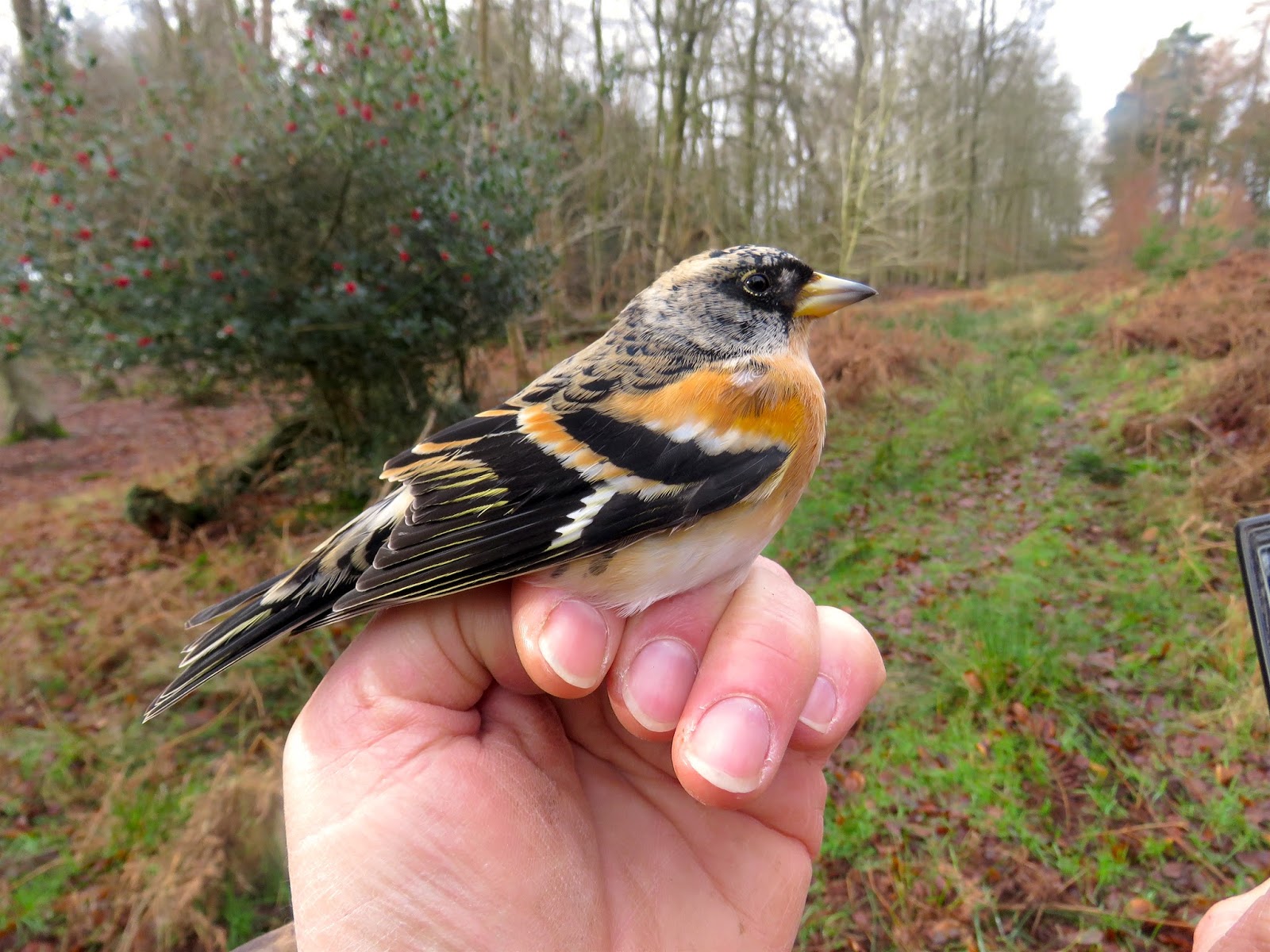
On any other day these birds would have been highlight by a mile but the Woodcock was sublime. Nonetheless Bramblings mesmerize me, particularly the males therefore catching 11 birds was brilliant. Matt has had a control (recapture of a bird not from this group that has a ring) from Norway! Data like this is brilliant so I'd be overjoyed to see one of these find their way over the North Sea into a Norwegian net; its contribution to science would be invaluable!

Pictured above is a dazzling male, showing off its orange ambience. Matt predicts this flock will grow till a peak around February/March of possibly up to a 100. Now wouldn't that be something?

 The female attempted to resemble the male but its flashes just aren't bright enough, aren't we men flamboyant, albeit clumsy (that applying to me) and less organised! I still believe the female presents a unique charm and possesses beautiful lemon armpits as does the male.
 The paparazzi were hot in this lad's tail but he seemed content perching on Matt's hand.

Another noticeable feature of Sunday's theme were the hats:

We all had are wooly hats undergoing extreme cool temperatures (5C)! Hopefully the next few weeks will provide us with out much needed winter weather...


Saturday, 9 January 2016

"Mama"... My Grandma's great shot 8th January 2016

Hi,

I seem to be on a bit of spree recently blog wise, but what's the bother? I seem to be enjoying it.
My Grandma visited Darts Farm (one of my popular birding haunts while in Devon) yesterday, eager to find a bit of white this Christmas, but no of course not snow, an Egret!

This was no ordinary Egret however, it was a Cattle, one that I have yet to see. I thought letting out my jealousy on this blog would be a way of terminating my bereavement. Both shots are from my old Canon SX50hs which looks to me like it's still producing the goods, bear in mind quality affected by email, but I hope you can appreciate what the original would be like...
Possibly a bit over exposed however I should - while with my Grandma - help resolve these issues. The prey in its mouth is in fact a Worm.
Great picture for comparison: note yellow bill of Cattle Egret (foreground), more compact look and shorter neck also straw coloured legs. 
So very Pleased with my Granny AKA Mama for producing a couple of good shots. I hope to use more of her's in the near future. 

Biff

Thursday, 7 January 2016

Cornwall, January 2nd 2016

Hi,
quick last report of what I saw on my last day down in Cornwall. I decided to stopover at Marazion on the way home for an authentic Cornish Pasty (what a joy) and in hope of finding the unfortunate Hudsonian Whimbrel. My plan of eating a pasty prevailed but my Whimbrel was to no avail, nonetheless 2 brilliant species made the visit worth while along with the pasty. 

The first was a "melanistic Pied Wagtail" that I called to my Mum and Dad which was flitting around on a a large stone wall, little did I realise that it was a pristine adult male Black Redstart giving fabulous views: 

After another good look around the few Waders on the seashore, I picked up a small dark one delicately picking up small crustaceans under stones, not a Turnstone but a Purple Sandpiper. Views obtained (as usual) were close and personal but constant "hurry up" cries failed me to land satisfactory shots. The first two are of the bird I saw today with a Turnstone in the background, the second couplet are of the views I obtained 9 months ago:

Just look at these beauties!

Believe it or not they swim!
Not a disappointing day without the - dare I say it - bland Hud Whimbrel! 

Friday, 1 January 2016

Cornwall 25th December to New Year's Day 2015-2016

Hi,
I've been having a great time down here in West Penwith, Cornwall. Although my resilience was put to the test (yep birding can be movie like) by the extreme 50mph gusts I held strong and found a few nice birds here and there. These are few of my highlights of my trip...

First of all Stonechats. These birds - for me - symbolise Penwith as they are found on any patch of Bracken, which of course is common here. Unusually there was a pair flitting between rocks on the seashore, the male was particularly showy before it dispersed into seemingly thin air!

Choughs in the last decade have quickly become a major part of the south-west Cornish landscape, with their call resonating around the rugged landscape. I seem to have become the buff of Choughs (this play on words took a while to think of so acknowledge them), for I have seen them on countless occasions. I was very sneaky this time round and managed to get very close without disrupting their avid feeding session. you won't be able to tell this however, because my hands were shaking like a Wagtail's tail in the strong winds! Contacting Nic who leads the Cornish Chough conservation project enabled me to know who these birds were: 2 yearlings who may have been in pursuit of there parents or have just reached independency. I did warn you on how bad these shots are, so grin and bear it.


The next on the list is a bit of a mouthful. A Devil's Coach Horse Beetle, no it's not a typo!
A couple of hundred metres further on than the Choughs I noticed an elongated Oil Beetle looking creature trundling across the path a foot in front of me. I knew instantly what it was and quickly directed it onto my hand. A kilometre walk on my hands were starting to hurt from its powerful jaws. But just around the corner my parents had "set up camp" for coffee and I could release it while they were drinking affording them good views. Thankfully from my perspective it gave its diagnostic and rather menacing, earwig-like, unworldly, alien etc. etc. pose. Didn't catch the moment but some nice shots nonetheless.


even though my photos are equivalent to modern art (abstract and horrible don't take offence just my opinion) it does in fact show a Merlin hawking round the cliff edge at Nanquidno. At first I thought it was a Swift and I was getting that incessant adrenaline rush with Pallid Swift in mind. Only to have a nice disappointment of it being a male Merlin! The wind was so strong it managed to keep the bird stationary for a minute until it effortlessly departed at pace round the cliff edge.

Although I didn't attain a good enough photo to post on my blog I think it's worth mentioning regular encounters with the Regulus kind, AKA Crests. Throughout my walks down into Cot Valley I was chaperoned by them, 10s of Goldcrests called from either side while Firecrests allowed fleeting glances as they light-footedly escalated Ivy bushes in pursuit of diminutive insects.

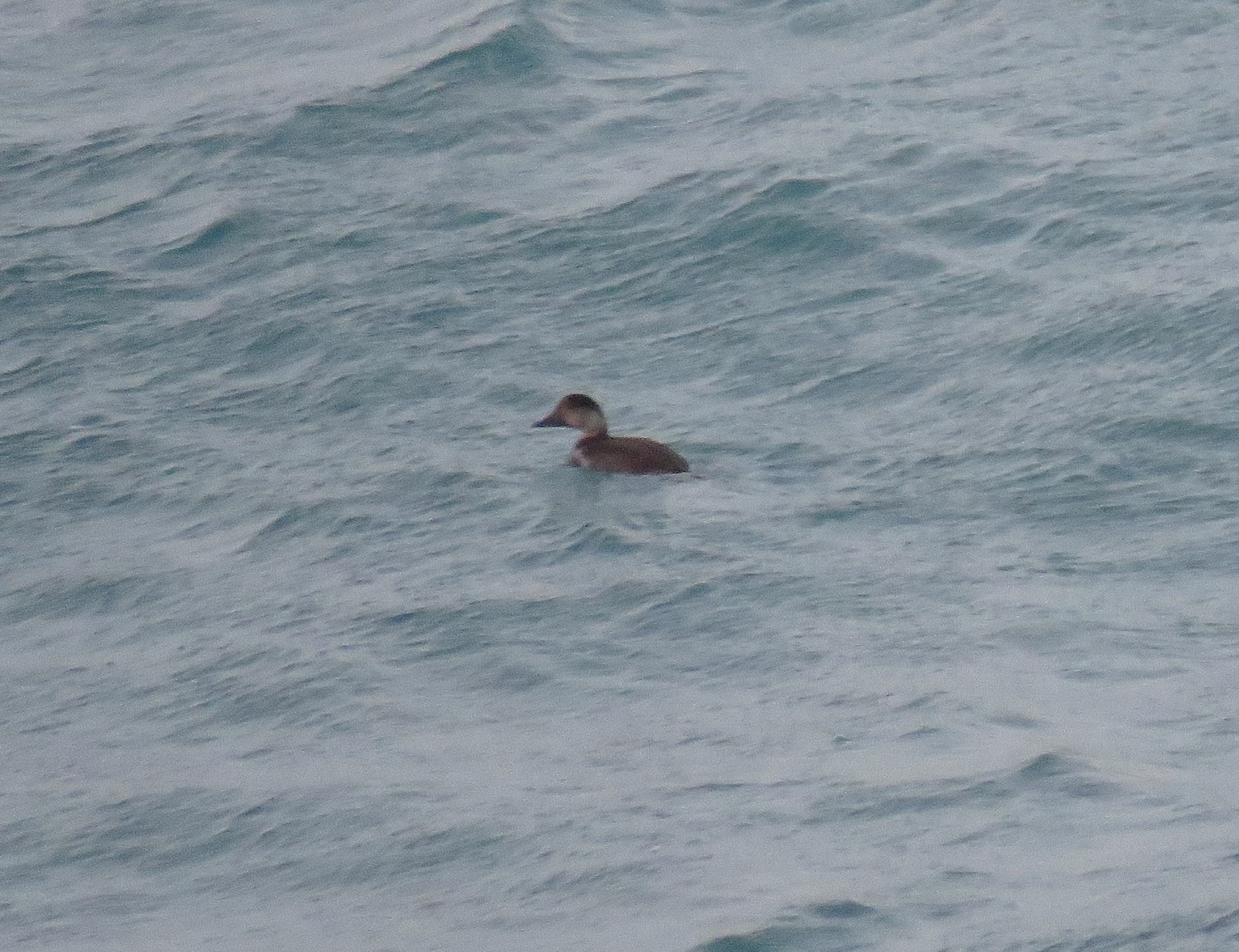
Common Scoters have always eluded me, distant unless ill and practically always at sea. Many people find large flocks migrating round prominent headlands. But I was one of the fortunate ones to see a less fortunate bird. This 1st winter female was just off Cot valley, bear in mind this is no cove just a stretch of coastline! Always getting further away, the bird didn't allow especially good photographic opportunities. I realise that I'm like a broken record but again the wind made me shake like a rattlesnake's tail!


Now to one of my most jaw-dropping episodes of the holiday gladly presented by the Great Northern Divers. These steeply browed loons travel from the northernmost reaches of Europe to winter grounds in places such as Penzance/Newlyn in search of a good spot of Common Shore Crab. While at Newlyn harbour realising the wind may force them in for cover I decided to walk on the wooden rafts in search of some. It was the correct decision, I came within 10 foot of a bird who kindly posed to counteract the horrendous light situation that has been going on since I had arrived. There were 4 in total. For me these are some of my best shots, I hope you agree:

I will post a separate piece on a beloved somewhat drab bird soon...